
PSL Scale Rating Chart: What Each Score (1–8) Actually Looks Like
Complete PSL Scale rating chart with specific facial metrics for each tier — symmetry %, canthal tilt, FWHR, gonial angle, and facial thirds. See exactly what separates a PSL 4 from a PSL 7.
The PSL Scale rating chart maps every tier of the 0–8 facial attractiveness scale to specific, measurable facial metrics — symmetry percentage, canthal tilt angle, facial width-to-height ratio (FWHR), gonial angle, and facial thirds balance.
According to GQ's 2025 investigation into the PSL Scale, this rating system has become one of the most referenced facial attractiveness frameworks on the internet, with millions of TikTok views and mainstream media coverage. This chart breaks down exactly what each PSL score looks like — the facial characteristics, metric ranges, and overall impression at every tier.
How to Read the PSL Rating Chart
Each tier below describes the facial characteristics, metric ranges, and overall impression typical at that PSL level. Two important principles:
-
PSL is a composite score. Someone can have one elite-level feature (like perfect canthal tilt) and still land at PSL 5 because other metrics pull the average down. Your PSL score reflects the overall picture, not any single measurement.
-
The scale is non-linear. The difference between PSL 4 and 5 is noticeable. The difference between 6 and 7 is dramatic. Each additional point at the top requires near-perfection across more and more metrics.
For the full list of measurements behind each metric, see our guide: What Is PSL? The Facial Attractiveness Rating Scale Explained.
PSL Rating Chart — Complete Breakdown
PSL 1–2: Severe Disharmony
| Metric | Typical Range |
|---|---|
| Symmetry | Below 75% |
| Canthal Tilt | Strongly negative (below -5°) |
| Facial Thirds | Severely imbalanced (>10% deviation) |
| Overall Impression | Pronounced structural issues across multiple areas |
This range is uncommon (roughly 1% of the population) and typically involves significant craniofacial conditions or untreated developmental issues. Multiple metrics fall well outside normal ranges simultaneously. GQ reported that the looksmaxxing community considers this range to be "extremely rare" in the general population.
PSL 3: Below Average
| Metric | Typical Range |
|---|---|
| Symmetry | 75–82% |
| Canthal Tilt | Negative (-2° to -5°) |
| FWHR | Below 1.7 or above 2.2 |
| Gonial Angle | Above 135° |
| Facial Thirds | Noticeably uneven (6–10% deviation) |
| Overall Impression | Recessed jaw, visible asymmetry, weak eye area |
At PSL 3, multiple metrics fall below average simultaneously. The positive: there's significant room for improvement. Reducing body fat to reveal underlying bone structure, starting a retinol-based skincare routine, and working on jaw definition can push someone from PSL 3 into the 4–4.5 range through softmaxxing alone. For the full improvement roadmap, see our guide: How to Do PSL Scale.
PSL 4: Average (Population Median)
| Metric | Typical Range |
|---|---|
| Symmetry | 82–88% |
| Canthal Tilt | Neutral to slightly negative (-2° to +2°) |
| FWHR | 1.7–2.1 |
| Gonial Angle | 128–135° |
| Facial Thirds | Roughly balanced (3–6% deviation) |
| Overall Impression | Normal, unremarkable — nothing stands out positively or negatively |
Most people land here. PSL 4 is the population median. The face is structurally sound but lacks standout features. People at this level often see the biggest gains from looksmaxxing because small improvements across several metrics compound quickly. Body fat reduction, improved skin quality, and better grooming can push into the 4.5–5 range.
According to looksmaxxing community data cited by GQ, approximately 92.7% of people fall between PSL 1.5 and 5.5. The average is PSL 4.
PSL 5: Above Average
| Metric | Typical Range |
|---|---|
| Symmetry | 88–92% |
| Canthal Tilt | Neutral to positive (+1° to +4°) |
| FWHR | 1.8–2.05 (closer to ideal) |
| Gonial Angle | 122–128° |
| Facial Thirds | Well-balanced (under 3% deviation) |
| Overall Impression | Clearly attractive, at least 2–3 strong features |
This is where people start receiving regular compliments about their appearance. The face has clear strengths — perhaps great eyes with positive canthal tilt, or a strong jawline with a good gonial angle. A PSL 5 would typically be rated a 7 or higher on a casual 1–10 scale. Most people consider this "good looking" without hesitation.
PSL 6: Attractive (Model Tier)
| Metric | Typical Range |
|---|---|
| Symmetry | 92–95% |
| Canthal Tilt | Positive (+3° to +6°) |
| FWHR | 1.85–2.0 (near ideal) |
| Gonial Angle | 118–125° |
| Facial Thirds | Nearly equal |
| Hunter Eyes | 7+ composite score |
| Overall Impression | Turns heads, strong harmony across all features |
The leap from PSL 5 to 6 is where everything clicks into harmony. It's not just one or two good features — it's the entire facial structure working together. Strong hunter eyes, a defined jawline, balanced proportions, and high symmetry all present simultaneously. Many successful models and influencers fall in this range. LooksMaxxers notes that PSL 6 represents the top ~5% of the population.
PSL 7: Very Attractive (Elite)
| Metric | Typical Range |
|---|---|
| Symmetry | 95%+ |
| Canthal Tilt | Positive (+4° to +7°) |
| FWHR | 1.9–2.0 (ideal range) |
| Gonial Angle | 115–122° |
| Golden Ratio Match | 90%+ |
| Hunter Eyes | 8+ composite score |
| Overall Impression | Exceptionally attractive — top ~1% |
PSL 7 is where genetic advantage becomes undeniable. Nearly every metric lands in the optimal range simultaneously. The face approaches golden ratio proportions (approximately 1:1.618). At this level, people are regularly told they should model, and their appearance is genuinely memorable. Less than 1% of the population reaches a true PSL 7.
PSL 8+: Elite Tier (Near-Perfect)
| Metric | Typical Range |
|---|---|
| Symmetry | 97%+ |
| All Major Metrics | Within ideal range simultaneously |
| Golden Ratio Match | 94%+ |
| Weak Metrics | Essentially none |
| Overall Impression | Near-perfect facial harmony — extremely rare |
True PSL 8+ is extraordinarily rare. Every measurable metric falls at or near its ideal value. There are no weak points dragging the composite score down. Faces at this level exhibit the kind of structural perfection that registers as universally attractive across cultures and demographics. A PSL 9 or 10 is largely theoretical — even the most famous faces in the world typically have at least one metric outside the ideal range.
Summary: The Complete PSL Rating Chart at a Glance
| PSL Score | Category | Symmetry | Canthal Tilt | FWHR | Gonial Angle | Population % |
|---|---|---|---|---|---|---|
| 1–2 | Severe Disharmony | <75% | < -5° | <1.7 or >2.2 | >135° | ~1% |
| 3 | Below Average | 75–82% | -2° to -5° | <1.7 or >2.2 | >135° | ~8% |
| 4 | Average | 82–88% | -2° to +2° | 1.7–2.1 | 128–135° | ~40% |
| 5 | Above Average | 88–92% | +1° to +4° | 1.8–2.05 | 122–128° | ~30% |
| 6 | Attractive | 92–95% | +3° to +6° | 1.85–2.0 | 118–125° | ~15% |
| 7 | Very Attractive | 95%+ | +4° to +7° | 1.9–2.0 | 115–122° | ~4% |
| 8+ | Elite | 97%+ | Optimal | Ideal | Ideal | <1% |
What Actually Moves the Needle Between Tiers
The PSL scale rewards harmony over any single feature — raising your lowest-scoring metrics has more impact than maxing out one that's already strong. The most common tier transitions:
PSL 3 → 4: Reduce body fat to reveal bone structure. Start mewing for jaw posture. Begin a consistent skincare routine.
PSL 4 → 5: Optimize body composition through training. Target specific weak metrics — if skin is dragging you down, a collagen and retinol protocol makes a measurable difference. Address grooming, eyebrow shaping, and hairstyle for your face shape.
PSL 5 → 6: Diminishing returns kick in. Gains require precision — targeted improvements to specific metrics rather than general self-care. Understanding exactly which measurements are holding you back becomes essential. Some people explore hardmaxxing options at this level.
PSL 6 → 7: Extremely difficult through softmaxxing alone. The gap is largely genetic, though maintaining peak physical condition, optimal body fat, and elite skincare can push borderline 6s into low 7 territory.
For a complete improvement strategy at every level, read: How to Do PSL Scale — The Complete Guide.
The Five Metrics Behind Every PSL Score
Every tier on the chart above is defined by five core facial metrics, each backed by published research. A meta-analysis by Rhodes (2006) in Psychological Bulletin (Vol. 132, No. 4) confirmed that facial symmetry, averageness, and sexual dimorphism are universal predictors of attractiveness across cultures.
1. Facial Symmetry
How balanced the left and right sides of your face are. Measured as a percentage — 82–88% is average, 92%+ is model-tier. More symmetrical faces consistently score higher in cross-cultural attractiveness studies.
2. Canthal Tilt
The angle of your eye tilt from inner to outer corner. Positive tilt (outer corner higher than inner) is considered attractive. Negative tilt is a common detractor. Ranges from strongly negative (below -5°) at PSL 1–2 to positive (+4° to +7°) at PSL 7+.
3. Facial Width-to-Height Ratio (FWHR)
The ratio of your face's width (bizygomatic distance) to its height (upper lip to brow). Ideal range is 1.85–2.0. FWHR correlates with perceived dominance and masculinity in men, and facial femininity in women.
4. Gonial Angle
The angle of your jawline measured from ear to chin. A sharper angle (115–128°) indicates a more defined jawline. Above 135° suggests a weaker or recessed mandible.
5. Facial Thirds Balance
How evenly your face is divided into three horizontal thirds (hairline to brow, brow to nose tip, nose tip to chin). Deviation from equal thirds is measured as a percentage. Under 3% deviation is well-balanced; over 10% is severely imbalanced.
Criticism and Limitations
The PSL Scale has drawn criticism from academics and cultural commentators:
- Researchers Anda Iulia Solea and Lisa Sugiura, publishing in SAGE Journals, describe it as "a systematic pseudoscientific framework that codifies the incel hierarchical worldview by ranking individuals through a racialised and gendered hierarchy."
- The Conversation notes that the scale "grew out of incel forums" and is now being monetized by influencers.
Our position: The geometric metrics behind PSL scoring (symmetry, proportions, dimorphism) are backed by published research. However, PSL captures only the structural component of facial appearance. It does not account for expression, personality, voice, confidence, or any of the qualities that matter most in real human connection.
Frequently Asked Questions
What is a PSL rating chart?
A PSL rating chart maps every tier of the 0–8 PSL Scale to specific, measurable facial metrics — including symmetry percentage, canthal tilt angle, FWHR, gonial angle, and facial thirds balance. It shows what each numerical PSL score actually represents in terms of facial structure and proportions.
What PSL score is considered attractive?
A PSL score of 5 or above is considered clearly attractive. PSL 5 features 2–3 strong facial metrics with overall above-average harmony. PSL 6+ (top 5%) is model-tier with strong harmony across all features. The average person scores around PSL 4.
What are the key metrics in the PSL rating chart?
The five key metrics are: facial symmetry (75–97%+), canthal tilt (-5° to +7°), facial width-to-height ratio (FWHR) (1.7–2.2), gonial angle (115–135°+), and facial thirds balance (measured as % deviation from equal thirds). Each PSL tier has characteristic ranges for these metrics.
How much can you improve your PSL score?
Most people can improve 0.5 to 2.0 PSL points through body fat optimization, skincare, sleep, posture correction, and grooming. Moving from PSL 3 to 4 or PSL 4 to 5 is achievable through softmaxxing alone. The gap from PSL 6 to 7+ is largely genetic.
Is the PSL scale the same as a 1–10 rating?
No. The PSL Scale uses a normal distribution (bell curve) on a 0–8 range. Most people cluster around PSL 4 (average). A PSL 6 would be rated 7–8 on a casual 1–10 scale. The PSL scale forces honest differentiation — genuinely high scores are statistically rare.
What is the difference between FWHR and gonial angle?
FWHR (Facial Width-to-Height Ratio) measures how wide your face is relative to its height — ideal range is 1.85–2.0. Gonial angle measures the jawline angle from ear to chin — ideal is 115–128°. Both are key metrics in PSL scoring but evaluate different aspects of facial structure.
Get Your Exact PSL Score
Ready to find out where you stand on the chart? PSL Scale uses AI to analyze 128+ facial landmarks across all five metrics — symmetry, canthal tilt, FWHR, gonial angle, and facial thirds — delivering a detailed breakdown with your exact score and personalized improvement recommendations.
Upload a clear, front-facing photo and get your results in seconds.
Sources
- GQ — Inside the PSL Scale
- Know Your Meme — PSL Scale
- LooksMaxxers — PSL Rating Chart
- LooksMaxxers — The Facial Metrics Behind Your PSL Score
- The Conversation — The Pseudoscientific Attractiveness Scale
- Rhodes, G. (2006). "The evolutionary psychology of facial beauty." Psychological Bulletin, 132(4), 592-613.
- SAGE Journals — Solea & Sugiura
Author

Categories
More Posts

What Is PSL? The Facial Attractiveness Rating Scale Explained
PSL is a 0-to-8 facial attractiveness rating system based on symmetry, proportions, sexual dimorphism, and facial harmony. Learn what PSL means, how the scale works in looksmaxxing, and where you fall on it.
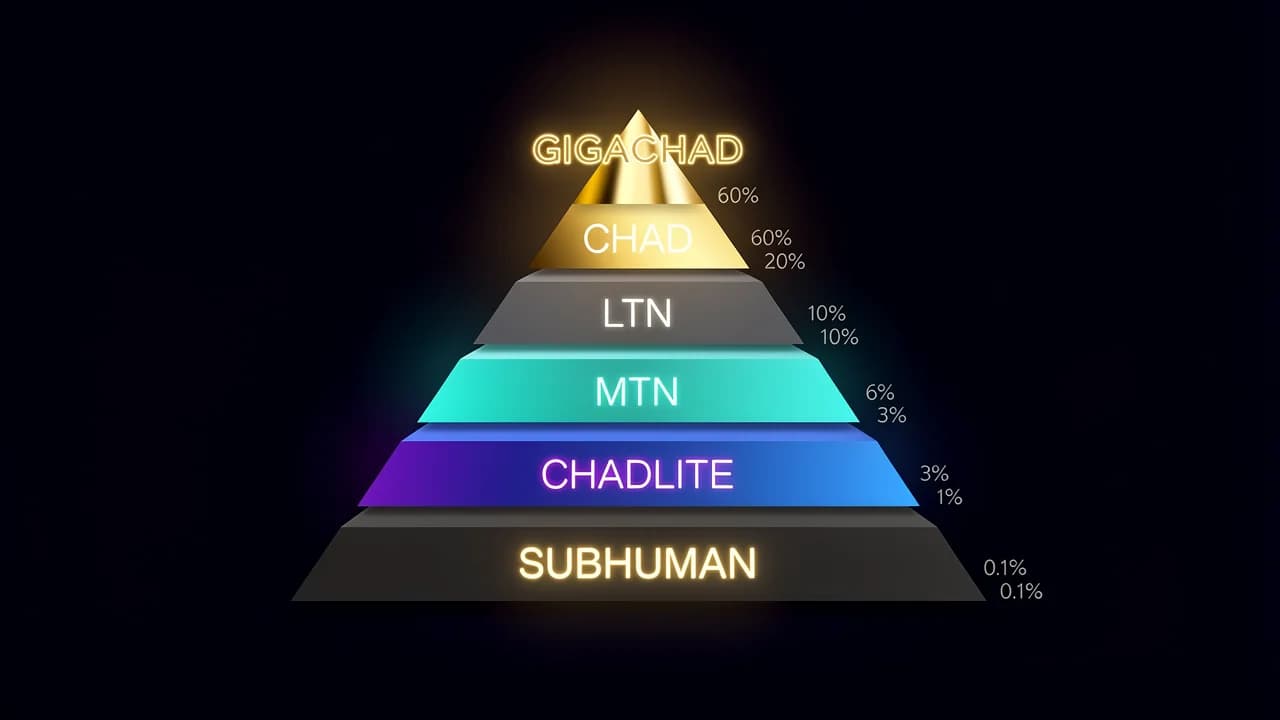
PSL Rating Tiers Explained: From Sub5 to Gigachad
Every PSL rating tier explained — Subhuman, LTN, MTN, HTN, Chadlite, Chad, and Gigachad — with exact score ranges, celebrity examples, and what each level means.

Hrithik Roshan PSL Rating: Where Does He Rank on the Facial Attractiveness Scale?
Hrithik Roshan's PSL rating analyzed using facial metrics — symmetry, canthal tilt, FWHR, jawline angle, and facial thirds. See exactly where the Bollywood star ranks on the PSL scale.