
What Is PSL? The Facial Attractiveness Rating Scale Explained
PSL is a 0-to-8 facial attractiveness rating system based on symmetry, proportions, sexual dimorphism, and facial harmony. Learn what PSL means, how the scale works in looksmaxxing, and where you fall on it.
PSL is a 0-to-8 facial attractiveness rating system that measures your face using five geometric criteria: symmetry, proportions, sexual dimorphism, skin quality, and facial harmony. A PSL score of 4 represents the population average; scores of 6+ place you in the top 5% of facial attractiveness.
According to GQ, the PSL Scale has become one of the most referenced attractiveness frameworks on the internet in 2025–2026, with millions of TikTok views and mainstream media coverage. This guide explains exactly what PSL means, how the rating system works, and what each score tier represents.
What Does PSL Stand For?
The acronym PSL has two accepted meanings:
-
Original meaning: PSL comes from three early internet forums — PUAhate, SlutHate, and Lookism — where the scale was developed by communities studying facial aesthetics and attractiveness.
-
Modern meaning: PSL is often redefined as Proportion, Size, and Lineation — the three core geometric principles that determine facial attractiveness.
According to Know Your Meme, the scale gained mainstream traction in the 2020s as "looksmaxxing" content exploded on TikTok and social media. GQ reported in December 2025 that PSL terminology has become "very, very mainstream" among teenagers and young adults.
How the PSL Scale Works
The PSL Scale rates faces on a 0-to-8 scale using a normal distribution (bell curve). This is fundamentally different from a casual 1-10 rating:
- 4 PSL = the population average (most people fall here)
- 5-6 PSL = above average to clearly attractive
- 7+ PSL = elite, model-level features (top 1%)
Why a Normal Distribution Matters
On a linear 1-10 scale, people tend to cluster around 5-7, making the scale almost meaningless. The PSL Scale forces a bell curve: most people are average (4 PSL), and genuinely high scores are rare. If you think everyone is a 7, you're using the wrong scale.
The PSL Score Tiers
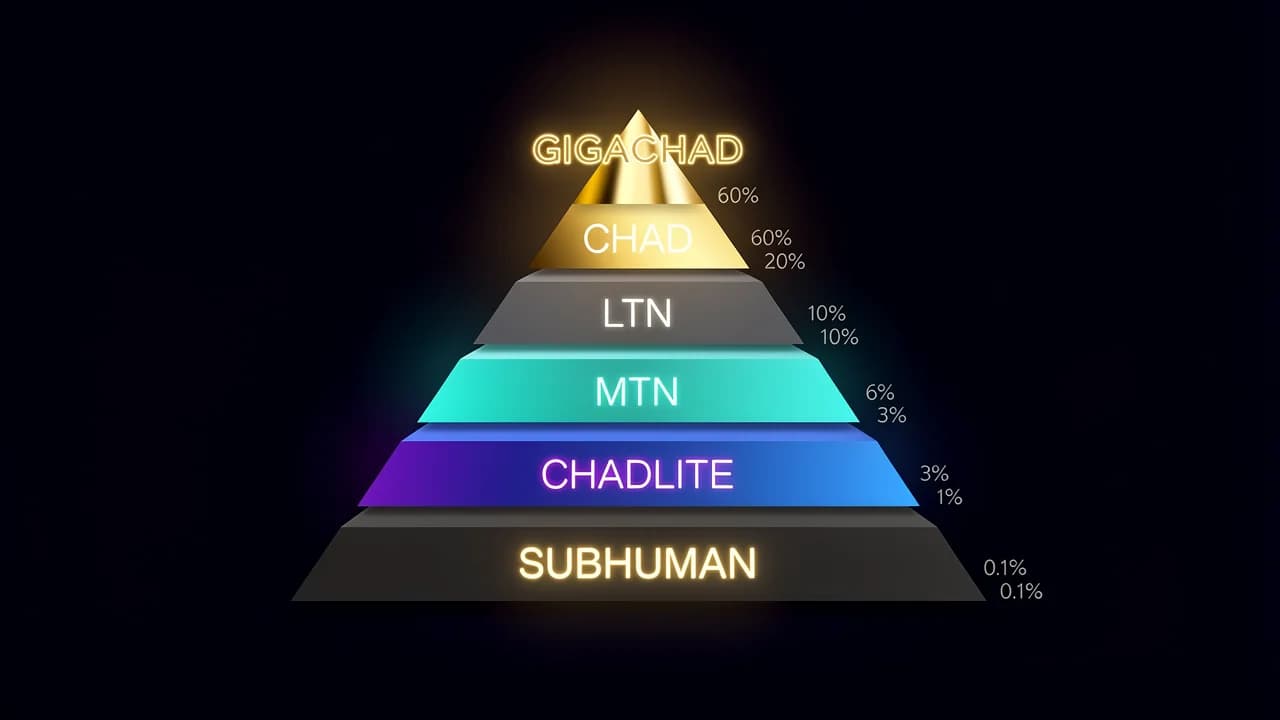
| PSL Score | Category | What It Means |
|---|---|---|
| 0-1.5 | Subhuman | Extremely low attractiveness; rare (~1%) |
| 1.5-2.7 | Low-Tier Normie | Below average; noticeable weak features |
| 2.8-4.5 | Mid-Tier Normie | Average range; no major flaws, no standout features |
| 4.6-5.9 | High-Tier Normie | Clearly attractive; good symmetry and structure |
| 6.0-6.8 | Chadlite / Stacylite | Model-tier; top ~5% |
| 6.9-7.4 | Chad / Stacy | Elite facial structure; top ~1% |
| 7.5+ | Adam / Eve | Near-perfect; extremely rare |
Key data point: According to GQ's reporting on looksmaxxing community data, approximately 92.7% of people fall between PSL 1.5 and 5.5. A score of 6+ is genuinely rare.
The Five Metrics Behind PSL Scoring
PSL evaluation is grounded in published research on facial attractiveness. A landmark meta-analysis by Rhodes (2006) in the journal Psychological Bulletin (Vol. 132, No. 4) confirmed that facial symmetry, averageness, and sexual dimorphism are universal predictors of attractiveness across cultures.
1. Facial Symmetry
How balanced the left and right sides of your face are. More symmetrical faces consistently score higher in cross-cultural attractiveness studies. Symmetry signals "developmental stability" — your face grew without significant environmental stressors.
2. Facial Proportions
How your features relate to each other geometrically. The Rule of Thirds (face divided into equal thirds vertically) and the Golden Ratio (approximately 1:1.618) are the primary reference points. Faces closer to these proportions tend to be rated as more attractive.
3. Sexual Dimorphism
How sex-typical your features are. For men: strong jawlines, prominent brow ridges, and defined cheekbones score higher. For women: fuller lips, higher cheekbones, and softer jawlines score higher. LooksMaxxers notes that dimorphism is one of the strongest predictors of PSL scores.
4. Skin Quality
Clear, even-toned skin signals health and youth. Skin quality directly affects how facial structure is perceived — poor skin can mask good bone structure, while healthy skin amplifies it.
5. Facial Harmony
How well all your features fit together as a whole. A face with individually average features but excellent harmony can score higher than a face with one exceptional feature and poor overall balance.
PSL vs. Other Rating Systems
| System | Scale | Focus | Distribution |
|---|---|---|---|
| PSL Scale | 0-8 | Facial geometry only | Normal (bell curve) |
| 1-10 Rating | 1-10 | Overall appearance | Linear (meaningless) |
| SMV | Qualitative | Face + height + status + wealth | Holistic |
The critical distinction: PSL measures your face. SMV measures your total value. A 5 PSL person with confidence, status, and social skills can have a much higher SMV than a 7 PSL person with none of those things.
PSL Scale and Looksmaxxing
The PSL Scale is the backbone of the looksmaxxing movement — the practice of systematically improving your facial appearance through evidence-based methods. On TikTok, Instagram, and Reddit communities like r/looksmaxxing, millions of people use PSL terminology to discuss facial metrics and track their progress.
Know Your Meme documents that the scale became mainstream as looksmaxxing content exploded across social media platforms in the 2020s. GQ reported that "looksmaxxing introduced these new things that supposedly define how good you look that no one would ever really think about before," and that PSL terminology is now "very, very mainstream" among young people.
Looksmaxxing strategies are typically divided into two categories:
- Softmaxxing: Non-surgical methods — body fat optimization, skincare routines, sleep improvement, posture correction, grooming, and styling. Most people can improve 0.5–2.0 PSL points through softmaxxing alone.
- Hardmaxxing: Surgical and medical procedures — rhinoplasty, jaw surgery, fillers, and other interventions. These target bone structure and facial features that softmaxxing cannot change.
The PSL Scale gives looksmaxxers a shared, measurable framework to evaluate progress. Instead of guessing whether a new skincare routine is working, you can track changes in specific facial metrics over time. For a complete softmaxxing and hardmaxxing guide, see How to Do PSL Scale — The Complete Guide.
Criticism and Limitations
The PSL Scale has drawn criticism from academics and cultural commentators:
- Researchers Anda Iulia Solea and Lisa Sugiura, publishing in SAGE Journals, describe it as "a systematic pseudoscientific framework that codifies the incel hierarchical worldview by ranking individuals through a racialised and gendered hierarchy."
- The Conversation notes that the scale "grew out of incel forums" and is now being monetized by influencers.
Our position: The geometric metrics behind PSL scoring (symmetry, proportions, dimorphism) are backed by published research. However, PSL captures only the structural component of facial appearance. It does not account for expression, personality, voice, confidence, or any of the qualities that matter most in real human connection.
How to Find Out Your PSL Score
There are two approaches:
Manual Estimation
Rate yourself across five areas:
- Jawline — Sharp and defined vs. weak or recessed
- Eye Area — Canthal tilt (upward = more attractive)
- Symmetry — How balanced left vs. right
- Harmony — Do your features fit together cohesively?
- Skin & Details — Clear skin, good eyebrows, clean proportions
AI-Powered Analysis
PSL Scale uses AI to analyze 128+ facial landmarks across all five metrics — symmetry, proportions, dimorphism, skin quality, and harmony — delivering a detailed breakdown in seconds.
For accurate results:
- Use the back camera (not selfie mode) to avoid lens distortion
- Take photos in natural, even lighting
- Use a neutral expression — no smiling or frowning
- Include both front-facing and profile shots
Frequently Asked Questions
What does PSL stand for?
PSL originally stands for the three forums where the scale was developed: PUAhate, SlutHate, and Lookism. In modern usage, it is often redefined as Proportion, Size, and Lineation — the three geometric principles behind facial attractiveness evaluation.
Is PSL the same as a 1-10 rating?
No. The PSL Scale uses a normal distribution (bell curve), not a linear 1-10 scale. Most people cluster around 4 PSL (average), making scores above 5-6 genuinely above average. A PSL 7 is statistically rare — top 1% of facial attractiveness.
What is a good PSL score?
A PSL score of 6 or above is considered clearly attractive. Scores of 7+ represent the top 1% of facial attractiveness and are considered elite or model-tier. The average person scores around 4 PSL.
How is PSL calculated?
PSL is calculated by analyzing five facial metrics: symmetry, proportions, sexual dimorphism, skin quality, and facial harmony. AI tools like PSL Scale use 128+ facial landmarks to compute these measurements precisely. Note that the weightings differ by gender — see our guide to PSL Rating for Women for how the scale adapts.
Can you improve your PSL score?
Yes. While bone structure sets a baseline, most people can improve by 0.5 to 2.0 PSL points through body fat reduction (12-15% for men), retinol-based skincare, sleep optimization, posture correction, and strategic grooming. Read our complete guide: How to Do PSL Scale.
What is the difference between PSL and SMV?
PSL measures only facial geometry (symmetry, proportions, bone structure). SMV (Sexual Market Value) includes your total value: face + height + wealth + status + social proof. A person with a moderate PSL score can have a high SMV through other factors.
Ready to Find Out Your PSL Score?
PSL Scale gives you an AI-powered facial attractiveness analysis based on symmetry, proportions, sexual dimorphism, skin quality, and facial harmony — with a detailed breakdown and personalized improvement recommendations.
Upload a clear, front-facing photo and get your results in seconds.
Sources
- Know Your Meme — PSL Scale
- GQ — Inside the PSL Scale
- The Conversation — The Pseudoscientific Attractiveness Scale
- LooksMaxxers — The Facial Metrics Behind Your PSL Score
- LooksMaxxers — PSL Scale Explained
- Rhodes, G. (2006). "The evolutionary psychology of facial beauty." Psychological Bulletin, 132(4), 592-613.
- SAGE Journals — Solea & Sugiura
Author

Categories
More Posts

PSL Scale Rating Chart: What Each Score (1–8) Actually Looks Like
Complete PSL Scale rating chart with specific facial metrics for each tier — symmetry %, canthal tilt, FWHR, gonial angle, and facial thirds. See exactly what separates a PSL 4 from a PSL 7.

Free PSL Face Rating Test Online: Get Your Score in Seconds
Take a free PSL face rating test online. Upload your photo and get an AI-powered facial attractiveness analysis across 8 dimensions — symmetry, harmony, facial structure, skin quality, and more.
PSL Rating Tiers Explained: From Sub5 to Gigachad
Every PSL rating tier explained — Subhuman, LTN, MTN, HTN, Chadlite, Chad, and Gigachad — with exact score ranges, celebrity examples, and what each level means.